


Oscars 2026: Michael B. Jordan Makes History, Wunmi Mosaku and “The Voice of Hind Rajab” Carry the Hopes of African Cinema

Los Angeles, March 15, 2026 – The 98th Academy Awards ceremony will go down in the annals as a night of contrasts for Africa and its diaspora. Between the historic triumph of Michael B. Jordan, the disappointment for the Tunisian film in the prestigious Best International Feature category, and the emergence of a new generation of talent, this edition highlighted both the victories and the battles still to be fought.
Michael B. Jordan, Sixth Black Actor to Win Best Actor
It was a historic and anticipated victory. At 39, Michael B. Jordan won the Oscar for Best Actor for his masterful performance in the supernatural thriller Sinners, directed by his long-time collaborator Ryan Coogler. In the film, he achieves the feat of playing twin brothers, Smoke and Stack, a dual performance that left critics and the Academy speechless.
Upon taking the stage at the Dolby Theatre, visibly moved, the actor delivered a powerful speech, paying tribute to the African-American legends who paved the way for him. He thus becomes the sixth Black actor in history to win this prestigious award, joining a very exclusive circle including Sidney Poitier, Denzel Washington, Jamie Foxx, Forest Whitaker, and (a moment of confusion on stage) his childhood friend.

“Michael B. Jordan accepts the Oscar for Best Actor for Sinners. Mike Blake / REUTERS”
Wunmi Mosaku, a Nigerian Star Shines on the Red Carpet
Although she did not take home the statuette for Best Supporting Actress for her portrayal of Annie in Sinners (the award ultimately went to Amy Madigan for Weapons), British Nigerian actress Wunmi Mosaku captivated audiences with her grace and emotion.
Born in Zaria, Nigeria, and trained at the prestigious Royal Academy of Dramatic Art (RADA) in London, Mosaku embodies a new wave of African actresses breaking through on the global stage without denying their roots. Her nomination, hailed in Nigeria as “a milestone for actors of Nigerian descent,” comes at a deeply personal time in her life: the actress, expecting her second child, had confided earlier in the year that she felt this recognition as “healing” for all Black women. Her journey, from Zaria to Hollywood via Manchester, illustrates the vitality of the African diaspora in the entertainment industry.

Tunisia at the Heart of the Political Battle
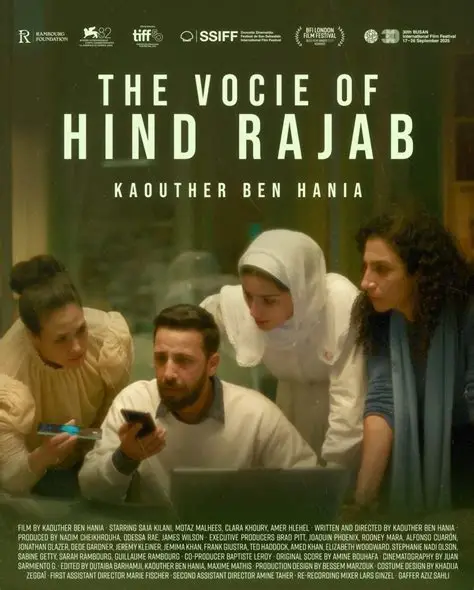
The continent’s other great hope rested on the shoulders of Tunisian director Kaouther Ben Hania. With The Voice of Hind Rajab, she created a powerful docudrama about the death of a five-year-old Palestinian girl in Gaza, blending archival emergency calls with dramatic reconstructions.
Already nominated in the past for The Man Who Sold His Skin and Four Daughters, Ben Hania became the first Tunisian filmmaker to secure three Oscar nominations. The film, which received a record-breaking near 24-minute standing ovation at the Venice Film Festival, carried the hopes of an entire continent. “If this film wins, it will be the continent’s fourth Oscar after Z (Algeria, 1969), Black and White in Color (Ivory Coast, 1976), and Tsotsi (South Africa, 2005),” wrote industry press ahead of the ceremony.
Its defeat by the Norwegian film Sentimental Value by Joachim Trier is seen as another setback for cinemas of the Global South, often confined to political subjects and too rarely rewarded for their pure artistic merit.
An Absence That Raises Questions: The Case of Nigeria
This 2026 edition will also be remembered for a notable absence. For the first time in several years, Nigeria, the giant of world cinema with Nollywood, did not submit any film in the Best International Feature category. The Nigerian selection committee, chaired by filmmaker Stephanie Linus, determined that none of the six proposals received met “the necessary technical and creative standards” to compete internationally.
This rare and courageous decision reignites the debate on the export quality of local productions and the AMPAS academic criteria. In 2019, the Nigerian submission Lionheart was disqualified because its dialogue was predominantly in English, a decision that sparked outrage across the continent, accusing the Academy of misunderstanding postcolonial realities.
A Glass Half Full: Increased Visibility
Despite the defeats and controversies, observers note a positive dynamic. While the Best International Feature prize did not materialize, the visibility was very real. Three African films (The Voice of Hind Rajab for Tunisia, On Becoming a Guinea Fowl for Zambia, and Don’t Let’s Go to the Dogs Tonight for South Africa) were on the eligibility list for Best Picture, a sign of the growing appetite from platforms and distributors for these stories.
“The presence of Nigeria’s Wunmi Mosaku, Liberian-American Delroy Lindo, and Michael B. Jordan, all of African descent, shows that the conversation about diversity in Hollywood doesn’t stop at the US borders,” analyzes a cultural critic. “It now includes the richness of talent from both the diaspora and the continent itself.” As the ceremony concludes, the path to more systematic recognition of African cinema still seems long, but this 2026 vintage, through the diversity and quality of its representatives, has laid another cornerstone in the edifice. With Michael B. Jordan now etched in history, Africa and its diaspora can look to the future with pride and ambition.
A.B.

